e-PAN vs Physical PAN Card: Which One Actually Works Better for You
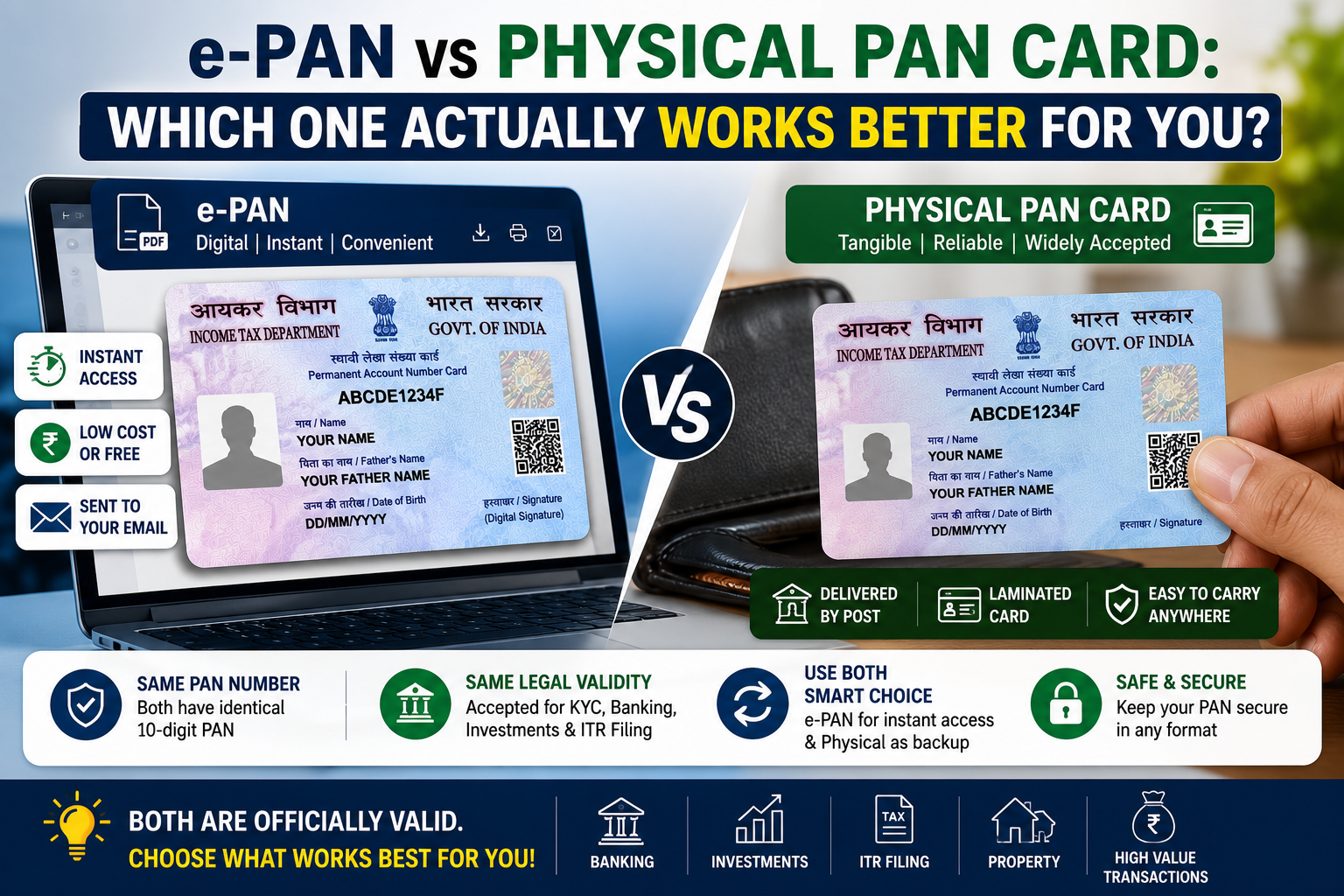
e-PAN vs Physical PAN Card. Both an e-PAN and a physical PAN card carry the exact same 10-digit PAN number and hold identical legal validity so the real question isn’t which one is “official,” it’s which one actually fits how you use your PAN day to day. Here’s a clear breakdown to help you decide.
An e-PAN is a digitally signed PDF sent to your email it’s instant, free or low-cost, and legally valid for KYC, banking, tax filing, and investments. A physical PAN card is a laminated plastic card delivered by post, useful when an office or institution specifically wants a hard copy. Most people don’t need both, but keeping the e-PAN as a backup even if you have the physical card is a smart habit.
What Is an e-PAN?
An e-PAN is the electronic version of your PAN card a password-protected PDF file containing the same details as the physical card: your name, photo, signature, date of birth, and 10-character PAN number. It includes a digital signature and, in newer versions, a scannable QR code for instant verification. It’s usually sent to the email address provided in your application, and can also be downloaded anytime from the Protean (NSDL) or UTIITSL portal using your PAN and date of birth.
What Is a Physical PAN Card?
A physical PAN card is the traditional credit-card-sized laminated document, featuring your photo, signature, date of birth, and PAN number, along with your father’s/parent’s name. After a successful application, it’s printed and dispatched by post to your registered address typically within 15–20 working days.
Are They Legally the Same?
Yes. The Income Tax Department does not distinguish between the two when it comes to legal validity. This is confirmed under Section 139A of the Income Tax Act and Rule 114 of the Income Tax Rules the mode of issuance, physical or electronic, does not change the validity of the PAN itself. Both:
- Carry the exact same PAN number
- Are accepted for KYC by banks, NBFCs, mutual funds, and stockbrokers
- Are valid for filing income tax returns, claiming refunds, and responding to tax notices
- Are accepted for high-value transactions like property purchases, vehicle sales, and large cash deposits
e-PAN vs Physical PAN: Side-by-Side Comparison
| e-PAN | Physical PAN Card | |
|---|---|---|
| Format | Digitally signed PDF file | Laminated plastic card |
| Delivery | Sent to your email, or downloaded from the portal | Dispatched by post to your registered address |
| Speed | Often available within minutes to a few days | Usually 15–20 working days |
| Cost | Free or low-cost, especially via Aadhaar-based instant e-PAN | Slightly higher fee; higher still for delivery to a foreign address |
| Access | Needs a phone, laptop, or tablet, plus a password to open | Physically carried in a wallet no device needed |
| Best for | Online KYC, digital banking, mutual fund investments, quick verification | In-person verification, offline institutions, situations demanding a hard copy |
| Risk factors | Tied to device security lost phone/laptop or a hacked account puts access at risk | Tied to physical safekeeping can be lost, stolen, or damaged |
| Backup value | Excellent backup if the physical card is lost or damaged | Reliable in areas with poor connectivity or no digital access |
| Legal validity | Identical to physical PAN | Identical to e-PAN |
When an e-PAN Works Better
- You need your PAN details immediately for an online KYC process
- You’re comfortable managing documents digitally and always have a phone or laptop handy
- You want a free or low-cost option, especially through the Aadhaar-based Instant e-PAN facility
- You’re an NRI or living abroad and want to avoid international courier delays and fees
- You want an easily accessible backup in case your physical card is ever lost or damaged
When a Physical PAN Card Works Better
- An office, bank branch, or government body specifically asks for a hard copy
- You’re dealing with a smaller or less tech-equipped institution that prefers physical verification
- You want a document that works even without a charged device or internet access
- You simply prefer having a tangible card in your wallet, the way you would a debit card
Can You Get Both?
Yes and for most people, this is the most practical choice. You can select both options during your PAN application, or apply for the physical card later even if you initially only opted for the e-PAN. Having both means:
- The e-PAN gives you instant access for urgent transactions
- The physical card serves as a permanent hard-copy backup
You do not need to apply for a new PAN number to get both formats remember, having more than one PAN number (not format) is illegal and can attract penalties. Requesting both a digital and physical copy of the same PAN is completely fine.
How to Download Your e-PAN
- Visit the Income Tax e-Filing portal, Protean (NSDL), or UTIITSL whichever you originally applied through.
- Select the e-PAN download option.
- Enter your PAN number (or acknowledgement number) and date of birth.
- Verify via OTP sent to your Aadhaar-linked mobile number.
- Download the password-protected PDF the password is typically your date of birth in DDMMYYYY format.
How to Get a Physical PAN Card
If you initially opted for e-PAN only and now want a physical card, or your existing card is lost/damaged, you can apply for a reprint using your existing PAN details through the Protean or UTIITSL portal no new application or new PAN number is needed.
Common Misconceptions
- “A physical card is the only legally valid form.” False the Income Tax Department treats both as equally valid.
- “An e-PAN is temporary or provisional.” False it carries the same permanent PAN number and never expires.
- “You must choose one or the other permanently.” False you can request both, and switch or add a format later without applying for a new PAN.
- “e-PAN can’t be used for high-value transactions.” False it’s accepted for property purchases, large deposits, and other significant financial activities, just like the physical card.
A Word on Security
- For e-PAN: Keep the PDF password-protected, avoid sharing it over unsecured channels, and protect the device it’s stored on with a strong password, PIN, or biometric lock.
- For physical cards: Store it safely, avoid carrying it unnecessarily if it’s rarely needed day-to-day, and report it immediately if lost or stolen so you can apply for a reprint.
FAQs
Is an e-PAN accepted for opening a bank account? Yes. Most banks, NBFCs, and financial institutions accept the e-PAN for KYC and account opening, since it holds the same legal validity as the physical card.
Does the e-PAN expire? No. Like the physical card, the e-PAN is tied to a permanent PAN number that never expires.
Can I convert my e-PAN to a physical card later? Yes. You can request a physical card reprint using your existing PAN details you don’t need to submit a fresh application or get a new PAN number.
Is the e-PAN free? In many cases, especially through the Aadhaar-based Instant e-PAN facility, it’s issued free of cost. Reprints or subsequent downloads may carry a small fee check the current charges on the official portal.
Which one should NRIs prefer? Most NRIs find the e-PAN more practical, since it avoids international courier delays and higher dispatch fees. Many still choose to also get the physical card as a long-term backup.
Can I use a photocopy or screenshot of my e-PAN instead of the original PDF? It’s best to always share the original digitally signed PDF where possible, since it carries the verifiable signature and QR code. A screenshot or photocopy may not carry the same verification features.
What if my physical PAN card is damaged but I still have the e-PAN? You’re not left without options the e-PAN remains valid for use in the meantime, and you can separately apply for a physical card reprint.
Conclusion
There’s no universally “better” option between an e-PAN and a physical PAN card both are equally valid in the eyes of the law, and the right choice comes down to how you use your PAN in daily life. If you’re comfortable going digital and want speed, the e-PAN is hard to beat. If you regularly deal with institutions that prefer paperwork, or simply like having a physical card in your wallet, get both there’s no downside to holding a digital and physical copy of the same PAN.