PAN Card for Companies, Firms & LLPs: Business Owner’s Guide

PAN Card for Companies. Whether you’re incorporating a private limited company, registering an LLP, or setting up a partnership firm, a PAN card is one of the first things you’ll need before you can open a current account, register for GST, or file your first tax return. Here’s exactly how business entities apply in 2026, including the form number change that came into effect this year.
Indian entities companies, LLPs, partnership firms, trusts, HUFs, AOPs, and BOIs apply for PAN using Form No. 94. Foreign entities incorporated outside India use Form No. 96. Both replaced the old Form 49AA (entity section) from 1 April 2026, and can be filed online through Protean (NSDL) or UTIITSL.
Which Form Does Your Business Need?
| Entity Type | Form to Use |
|---|---|
| Private/Public Limited Company (incorporated in India) | Form No. 94 |
| LLP (registered in India) | Form No. 94 |
| Partnership Firm (registered in India) | Form No. 94 |
| Trust, HUF, AOP, BOI, or Artificial Juridical Person (formed in India) | Form No. 94 |
| Local Authority (in India) | Form No. 94 |
| Company/LLP/Trust incorporated or formed outside India | Form No. 96 |
The deciding factor is simple: if your entity is incorporated or formed in India, you use Form 94, regardless of the type of entity. If it’s incorporated or formed outside India, you use Form 96.
Why the Form Numbers Changed in 2026
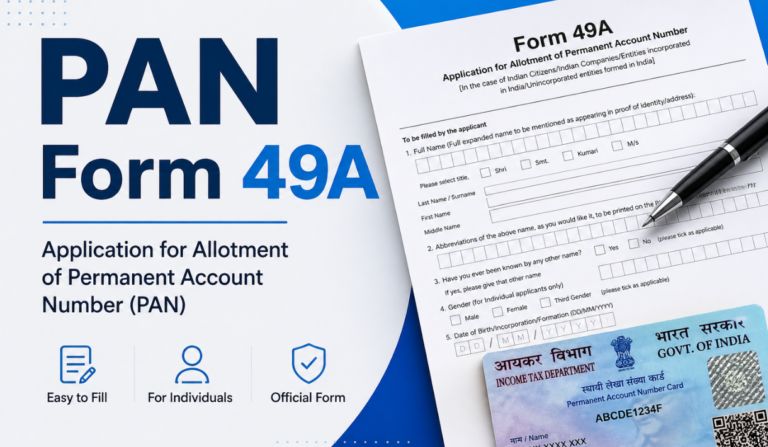
Under the Income-tax Rules, 2026, effective from 1 April 2026, the earlier Form 49A and Form 49AA were replaced by four new forms 93, 94, 95, and 96 as part of the transition to the Income Tax Act, 2025. For businesses, this means:
- The entity portion of the old Form 49A is now Form 94 (Indian entities)
- The entity portion of the old Form 49AA is now Form 96 (foreign entities)
Applications submitted using the old form numbers after 1 April 2026 are not processed. If your application was already pending as of 31 March 2026, it remains valid, and you don’t need to reapply.
Documents Required for Indian Entities (Form 94)
| Entity Type | Proof of Identity/Registration |
|---|---|
| Company | Certificate of Incorporation and CIN (Corporate Identification Number) |
| LLP | Certificate of Registration and LLPIN (LLP Identification Number) |
| Partnership Firm | Certificate of Registration issued by the Registrar of Firms, or Partnership Deed |
| Trust | Certificate of Registration Number and Trust Deed |
| AOP / BOI | Certificate of Registration Number, agreement, and a government document establishing identity and address |
| Local Authority / Artificial Juridical Person | Government document establishing identity and address |
For address proof, if the applicant’s communication address differs from the registered office address, separate proof of that communication address must also be submitted.
Documents Required for Foreign Entities (Form 96)
- Certificate of incorporation/formation issued in the country of origin
- Proof of date of incorporation
- Tax Identification Number (TIN) of the entity in its home country this is mandatory for Form 96 applicants
- Proof of address in the country of incorporation
How to Apply Online Step-by-Step
- Visit the official Protean (NSDL) or UTIITSL PAN application portal.
- Under Application Type, select “New PAN – Form No. 94 (Indian Entity)” or “New PAN – Form No. 96 (Foreign Entity)” as applicable.
- Select the correct Category (Company, LLP, Firm, Trust, AOP, BOI, etc.).
- Fill in the entity’s name, date of incorporation/formation, registration number (CIN/LLPIN, where applicable), email ID, and phone number, then submit.
- Choose the document submission mode digital e-KYC/e-Sign where available, or physical document submission.
- Enter the remaining details, including the entity’s registered office address, communication address (if different), and the appropriate AO (Assessing Officer) code.
- Upload scanned copies of the required registration and identity documents.
- Pay the applicable fee via net banking, card, or demand draft.
- If submitting physically, print the signed acknowledgement (signed by an authorised signatory of the entity) along with self-attested documents, and post them to the processing address shown on the portal.
- Save your acknowledgement number to track the application.
Domestic companies and LLPs can alternatively apply through the Common Application Form (CAF) integrated with the Ministry of Corporate Affairs (MCA) portal at the time of incorporation this is often the fastest route for brand-new companies, since PAN allotment happens alongside company registration itself.
Can an Authorized Representative Apply on Behalf of the Entity?
Yes. A Representative Assessee (RA) or Authorized Representative (AR) typically a director, designated partner, or authorized signatory can file the PAN application on behalf of the entity.
Fees
Entity PAN application fees follow the same broad structure as individual applications a lower fee for an Indian communication address, and a higher fee (covering international dispatch) for a foreign communication address. Since exact amounts are revised periodically, confirm the current fee for your applicant category on the Protean or UTIITSL portal before submitting payment.
Can You Correct Entity PAN Details Later?
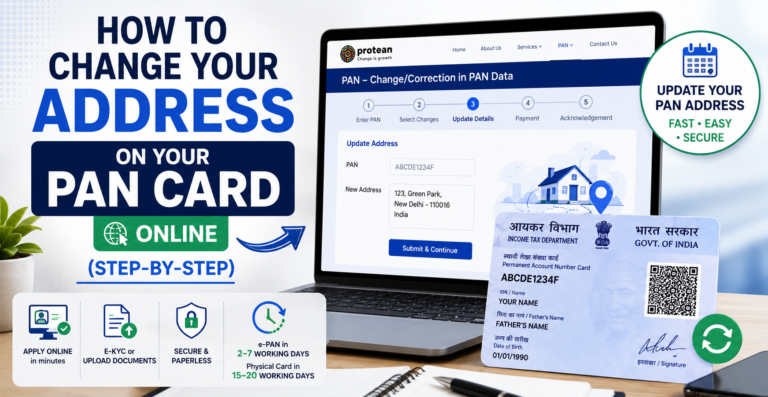
Yes. If any registered details change later such as a change in registered office address, entity name after a legal name change, or authorized signatory this is filed using the PAN CR-2 correction form for non-individual applicants (the entity equivalent of the individual PAN CR-01 form).
Common Mistakes to Avoid
- Using the old Form 49A/49AA reference instead of the current Form 94/96, which can delay processing.
- Submitting an outdated Certificate of Incorporation that doesn’t reflect a recent name change.
- Forgetting to provide separate proof for the communication address when it differs from the registered office.
- Missing the mandatory TIN for foreign entities applying via Form 96.
- Applying through an authorized signatory whose authority isn’t clearly documented (e.g., without a board resolution or authorization letter, where required).
- Delaying PAN application until after trying to open a bank account or register for GST most of these steps require PAN already in hand.
FAQs
Does every business entity need its own PAN, separate from the owner’s personal PAN? Yes. A company, LLP, firm, or trust is treated as a separate legal entity and requires its own distinct PAN, regardless of the personal PAN held by its directors, partners, or trustees.
Can a sole proprietorship apply for a separate PAN? No a sole proprietorship is not a separate legal entity, so it uses the proprietor’s own individual PAN for all business and tax purposes.
What form does a One Person Company (OPC) use? An OPC, being incorporated under the Companies Act, uses Form 94, the same as other Indian companies.
Can a foreign company operating a branch office in India use Form 94 instead of Form 96? No the form depends on where the entity is incorporated, not where it operates. A foreign-incorporated entity uses Form 96 even if it has a branch or liaison office in India.
Is a PAN mandatory before registering for GST? Yes. PAN is a prerequisite for GST registration, since your GSTIN is structured around your PAN.
How long does entity PAN allotment take? This varies depending on the completeness of documentation and category, but applying through the MCA’s Common Application Form during incorporation is often the fastest route for new companies and LLPs.
Can the entity’s PAN be corrected after allotment? Yes, through the PAN CR-2 correction form for non-individual applicants, used for updating details like registered address or entity name.
Conclusion
Getting a PAN for your company, LLP, or firm is a foundational step before you can open a bank account, register for GST, or start filing returns and in 2026, the main thing to get right is using the correct current form: Form 94 for entities incorporated in India, or Form 96 for those incorporated abroad. If you’re setting up a new Indian company or LLP, applying through the MCA’s integrated application process at the time of incorporation is often the simplest way to get it done.